


I'm back! With one more operating principle to complete the set.
The concepts we've been exploring so far this month are all about being actively engaged with our creativity and using the energies of spontaneity, immediacy, weirdness, experimentation, and play as both sparks for generating new work and as guiding forces for more consistently inspired progress on existing projects. But at some point, it does become necessary to invite the inner adult back into the room and get down to the business of sorting things out.
For the record, I'll concede that:
1. Employing the brilliantly choreographic power of the intellect is usually necessary to make interesting art, well, interesting.
2. Clarifying vision and deliberating over corresponding craft choices are modes of (creative) operation, too, and
3. At some point we have to start exerting more thoughtful pressure and influence on whatever we're making if we want it to be the best and most resonant Whatever it can be.
But! We're talking sparks, we're talking Whatevers, but we're not talking craft just yet. We're still circling process and approach.
So here we are at the fourth and final principle in the set:
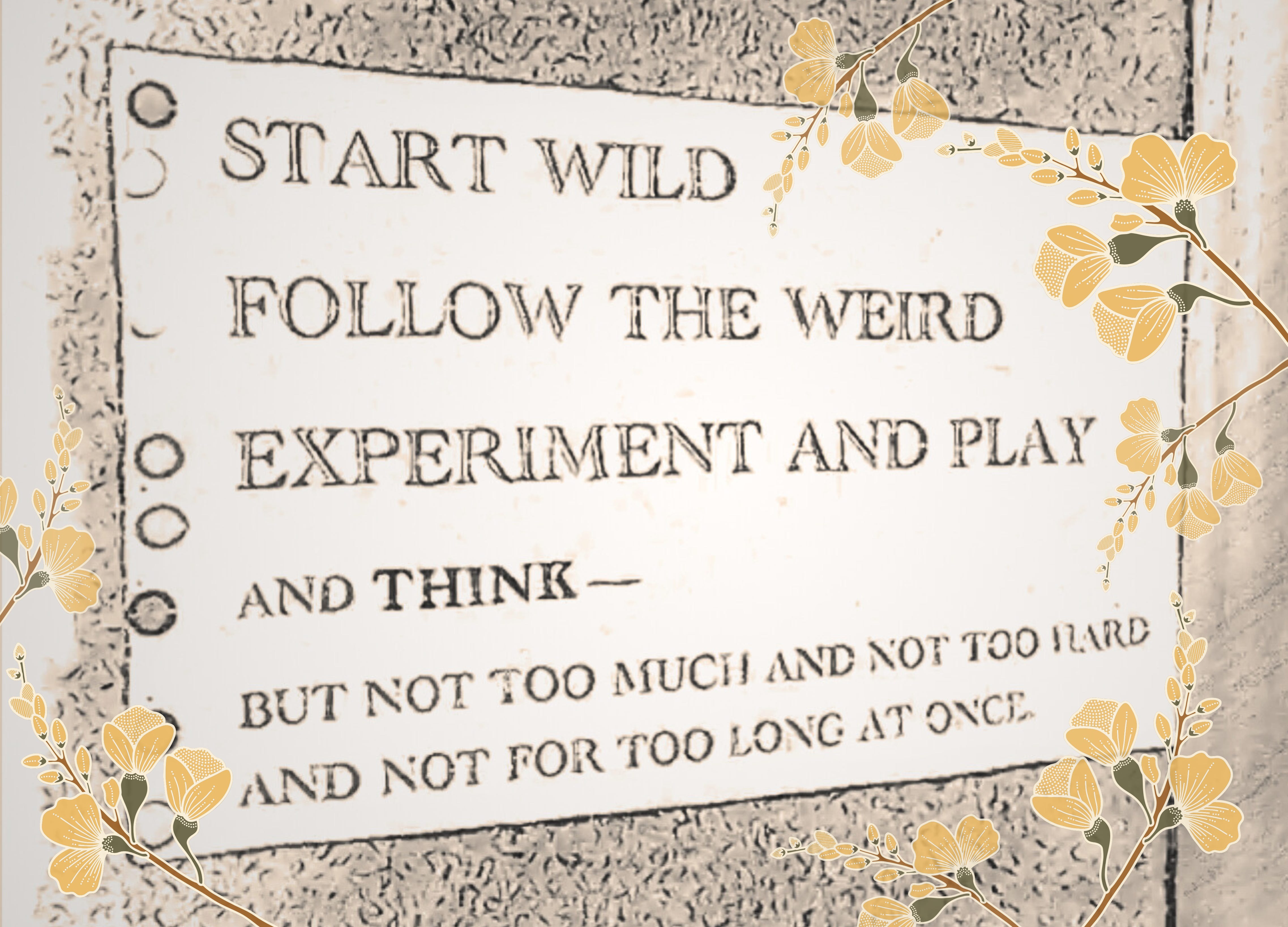
THINK—but not too much, not too hard, and not for too long at once.
The idea here is to make thinking the exception, NOT the rule. The first 3 principles are the rules. (Okay, no rules! But the buoys, let's say. Anchors—we're talking anchors.)
This last one is the thing that pops up then falls away or dissolves as you go along, swimming with the others, pops up again. The moment when you come up for air (MOMENT, not minute, not hour, not always!) before you mermaid yourself back down there to keep swimming, swimming.
TANGLE
The caveats here (much / hard / long) will be different for each of us, and will depend on what we're working with, what we want it to do, and what stage of its process we're in. They will be fluid. The principles themselves aren't really intended to be followed in a straight line, either (it's more of a loop-de-loop) but I do think there's a case to be made for this one, THINK, being last.
1-3 are a tangle of wires that, by the end—by starting wild again and again, following the weird repeatedly along the way, experimenting, playing, and okay, fine, yes, at some point, thinking—we'll untangle. Once thinking is engaged, all four can tangle together and we can swim between them.
For me, the THINK, BUT caveats mean:
Not too much: don't let the rational mind crowd your imagination out.
Not too hard: don't let the rational mind bully your creative instincts.
Not for too long at once: don't give the rational mind the time/space it needs to go rogue, organize, stage an uprising, and take over.
📝
I'm in a phase of my novel project right now, for example, where I have to think quite a bit more than I'm used to, but I've discovered that it can be really quite dynamic and imaginative in its own way. I'm playing with my more foundational operating principles (1-3) as I go, and it's fun and interesting to spin wildness, weirdness, possibilities, and playfulness into my process of thinking through things.
It makes the necessarily practical aspects of the project more creatively productive, more surprising, and a lot more fun. I mean if I have to wear my thinking cap while I'm doing this, I'm going to have to glue some feathers and sequins and stuff on it. Maybe one of those prank flowers that shoots water at people. Why not? I've never been a pragmatist and I'm not going to start now. I make it up as I go along.
Workable strategies for resisting the impulse to overthink:
MEDITATION is one of the very best ways to develop self (mind) awareness, so you notice when you're spinning out and can pump the break. This is a practicable superpower (i.e. it becomes a superpower for pretty much anyone willing to practice it) that is invaluable in pretty much every area of our lives. There are some fantastic apps that help you learn and start practicing—I really like the Happier app (formerly ‘Ten Percent Happier’). I'd love for someone to be paying me for saying that but alas, nobody is (lol). I just really like it and have been using it for several years.
HAVE A SENSE OF HUMOR. Don't take yourself too seriously—take yourself just seriously enough. Again, it's a spectrum, depending on All The Things. But it's important to keep a light heart. Even hard work, in this field, can be a source of happiness, energy, and hope in our lives when we stay connected to the feeling of creating.
These two (good humor and mindfulness) are like the crowd-control officers who can keep things from getting out of hand when the intellect shows up at the party with all its interesting but sometimes unwelcome friends.
Experiments in creative thinking:
WORK PLAY IN ✨ to your thinking sprints. Again, I love incorporating color and imagery to the process. The mind is a dynamic, prismatic place and opens to us more when we appreciate that. I mean, why not think by drawing? Dancing? Collaging? Try playing some games (see last week's broadcast for a couple ideas) either as part of your thinking process or as a break from it (recess again!).
MIND MAPS ✨ are a fantastic way to keep the creative sparks pinging while muddling through stuff; a mind map really appeals to my associative tendencies. Associative thinking is by nature loose, and mind mapping facilitates it. Makes a good loop. Sometimes I get cute with it, just because prettying things up makes it more fun, pleases me, and nourishes my imagination and my sense of softening order with idiosyncrasy. THINK as its own little side-jammer art project. Why not?
And since we've brought mermaids, sparks, buoys, anchors, feathers, sprints, jammers, and loops to this picnic, here's one more metaphor to stuff in the basket before we go:
Thinking is the wrapper, not the cupcake itself. Or maybe it's the candle. . .
The joy you feel when your creative practice and principles reflect your love for the process? The cup of sugar you poured in there. The sweet, bright cherry on top!
The feeling is the shimmering inner light that shines through it all.
Tend it! Prioritize and protect it. And above all, enjoy it.
How do you keep your mind loose when you have to wear your thinking cap? What can you try this week to find balance between these modes in your own practice? If you feel like sharing, I'm all eyes in the comments. 💛
Love & light from the margins,
ali ✨
Star in the Margin is free and open to all, but does require lots of time, love, and energy! If you’re into the vibe and want to cheer me on. . .